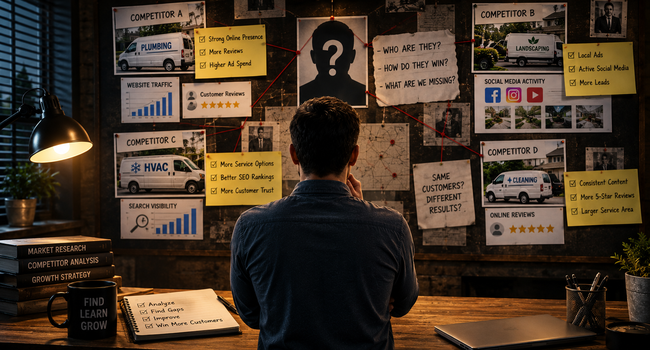
There's a version of losing customers that you never find out about.
The phone doesn't ring with a complaint. No email explains why. Nobody cancels with a reason. The customer just searches for what they need, finds someone who looks more visible or more credible, and calls that business instead. You never hear about it. You never see it happen. And you keep operating under the assumption that things are going reasonably well, because nothing obviously went wrong.
This is how most small businesses lose customers in 2026. Not dramatically. Quietly. According to Agency Dashboard's 2026 competitive analysis report, 44% of companies admit to having zero competitor visibility. They are operating completely blind while rivals are systematically capturing their market share.
The Invisible Loss Problem
Most business owners have a good instinct for the problems they can see. A bad review gets a response. A slow month prompts a boost on social media. A competitor dropping their prices gets noticed at the quote stage.
What they don't have is any visibility into what's happening before those signals appear. The customer who chose a competitor three weeks ago never gave you the chance to respond. The enquiry that went to the business ranking above you never reached your inbox. The referral that went quiet during the verification stage never showed up in your missed calls.
As LeadsAgent's 2026 small business analysis, a local business loses an estimated 20 to 35% of referred customers during the verification step. That is the moment between a customer hearing about your business and deciding to contact you. They Google the name. They check the reviews. They look at the website. And if what they find doesn't match the confidence of the referral, they call someone else instead. The business that made the referral never finds out. The business that lost the customer never finds out. It just doesn't happen.
This is the invisible loss problem. And it compounds over time, because the competitors capturing those customers are building review counts, GBP authority, and referral networks while the businesses losing them remain unaware of the gap widening underneath them.
Why the Gap Exists in the First Place
Most small business owners are not losing customers because they're doing bad work. They're losing them because of a structural visibility problem that builds slowly and shows up in revenue long after the cause becomes fixable.
There are three reasons the visibility gap exists:
1. Competitors move and you don't know about it
A competitor adds six new service area pages. Another increases their review velocity from two reviews a month to fifteen. A third updates their Google Business Profile every week and starts appearing in Map Pack results where they weren't before. None of this triggers an alert. None of it sends you an email. You find out when you notice the phone is quieter than it used to be, and by that point the gap has been widening for months.
As Thryv's 2026 competitor research guide, in 2026 AI-driven search, local results, and customer reviews amplify competitive differences faster than ever before. A competitor making the right moves in January could be outranking you for your most valuable keywords by March. The pace of change has accelerated while most small businesses' awareness of it has stayed static.
2. The customer journey is now mostly invisible
When word of mouth was the primary growth channel, you had some visibility into competitive dynamics. You knew which businesses operated in your area. You occasionally heard who a customer had tried before they called you.
That feedback loop has largely disappeared. The modern customer journey for most small business marketing strategies contexts plays out almost entirely online before any contact is made. Search. Map Pack. Reviews. Website. And the customer has already decided before they pick up the phone. The businesses that appear credible and visible in those first 60 seconds of research win the job. The ones that don't, don't hear from that customer at all.
3. Most businesses measure what they have, not what they're missing
The metrics most small businesses track tell them about themselves. Website visitors. Call volume. New enquiries this month versus last month. These are all looking inward.
What they don't tell you is what your competitors are ranking for that you're not. Which keywords are sending customers to a competitor's site. How your review count compares to the businesses appearing above you in local search. What your local market share looks like across the five suburbs where you do most of your work.
Without that outward view, the data you have only tells you how the business is performing in isolation. It can't tell you whether that performance is good or poor relative to what's possible in your specific market.
What the Visibility Gap Actually Costs
The cost of not knowing who you're losing to is not theoretical. It shows up in specific, measurable ways.
- Lost jobs you never quoted on. When a customer finds a competitor in the Map Pack and you're not there, you never get the chance to quote. You don't see that loss. But your competitor sees the win.
- Referral leakage. A customer refers you to a friend. The friend Googles your business and finds a thin profile, an outdated website, and fewer reviews than the business ranking above you in search. They call that business instead. The referring customer assumes you got the job. You never knew you were in the running.
- Price pressure you don't need to accept. When a competitor appears more established and visible, they can charge more. When you appear less visible, customers use price as the differentiator. The visibility gap often creates the pricing pressure, not the actual quality difference.
- Compounding disadvantage. The competitor capturing the customers you're losing is building review velocity, referral networks, and local search authority. Every month the gap isn't addressed, their position strengthens and yours falls further behind.
According to Agency Dashboard's 2026 report, companies using competitive insights to guide decisions achieve 22% higher customer satisfaction scores and measurably stronger revenue growth. That number reflects the upside. The other side of it is what businesses that stay blind are leaving behind.
The Businesses That Are Winning Locally Have One Thing in Common
In almost every local market, one or two businesses have a significantly stronger visible presence than everyone else. More reviews, more GBP activity, higher local search rankings, more service area pages. And they are almost always capturing a disproportionate share of the leads.
This isn't luck. As The Viziers' 2026 local visibility analysis, in 2026, if you aren't showing up at the top of search results when people look for your type of business, you don't exist to them. The businesses appearing at the top of the Map Pack, with consistent reviews and a complete GBP, have built that position systematically over time. They are not doing dramatically different work. They have a dramatically better marketing system.
The gap between those businesses and the ones they're outcompeting is not talent or quality. It's visibility. And visibility is a marketing strategy for small business problem, which means it's a solvable one. But you cannot solve a problem you cannot see.
What Changes When You Can See the Gap
Understanding your competitive position changes the decisions you make about where to spend time and money. This is the foundation of doing digital marketing for small business well: fix the visibility gap before spending on anything else.
When you know a competitor has 80 reviews and you have 12, you know exactly what to prioritise. When you know a competitor ranks for three service area keywords you don't appear in, you know where the content gaps are. When you know a competitor's GBP is updated weekly and yours was last updated four months ago, you know what to fix before anything else.
This is why competitor analysis is important for small business: not to copy what competitors are doing, but to stop being blind to the specific gaps that are costing you customers right now. The businesses that grow consistently in competitive local markets are the ones with a clear picture of where they stand relative to the competition, not just where they stand in absolute terms.
As we covered in our blog on what a real marketing strategy actually looks like, a marketing strategy without a competitor snapshot is working in the dark. The snapshot doesn't have to be complicated. It just has to exist.
And as Hover's 2026 small business visibility guide notes, most small businesses don't lose customers to dramatic competitive moves. They lose them to small, fixable gaps like a review page that looks too thin to trust, a GBP that hasn't been updated, or a website that doesn't load fast enough on mobile. The gap is fixable. But only once you can see it.
The 2026 Dimension: AI Search Is Widening the Gap Faster
There is a new layer to the visibility problem in 2026 that most small businesses haven't registered yet.
Customers are increasingly finding local businesses through AI tools like ChatGPT, Perplexity, and Google's AI Overviews before they ever see a traditional search result. As an IssueWire report from May 2026, small businesses are losing customers every single day to competitors who show up in AI search results, and most do not even know it is happening.
AI tools pull recommendations from structured, well-cited content. Businesses with more reviews, more consistent GBP data, and more location-specific content appear in AI recommendations more often. Businesses without those signals are invisible to a growing portion of the customer journey. If your business already suspects it has this problem, why customers can't find your business online is worth reading next.
Why digital marketing is important for small business in 2026 has a new answer: because the channels customers use to find businesses have expanded beyond Google search, and the businesses that understand which channels their competitors are appearing in are the ones making the right decisions about where to invest.
You Can't Fix a Gap You Can't See
Most small businesses will read this and recognise the problem. The phone is a little quieter than it used to be. Growth has plateaued. Some months feel harder than they should. And there's no obvious explanation for why.
The explanation is usually the visibility gap. A competitor made a series of moves over the past 12 months that you weren't tracking, and they're now consistently appearing where you aren't. The customers going to them never tell you they're going to them.
The first step is finding out what the gap actually looks like for your specific business in your specific market. Not a generic industry benchmark. Your competitors. Your keywords. Your service areas. Your position in the Map Pack relative to the businesses capturing the leads you're missing.
That's exactly what the free Amp'd Local Competitor Analysis is designed to show you. Not a methodology for doing your own research. A clear picture of where your competitors are winning in your local market right now, and what it would take to close the gap.
As we covered in our post on why small businesses lose leads after the first click, the gap between visibility and revenue is almost always fixable once you know where to look. The businesses that stay invisible to the problem are the ones that don't look.
Frequently Asked Questions
How do I know if I'm losing customers to competitors without realizing it?
Usually you don't find out directly. Watch for a phone that's quieter than steady traffic would suggest, referrals that go cold after the first Google search, or a competitor whose reviews and Map Pack presence grew fast while yours stayed flat. Those are the visibility-gap signs this post covers.
What's the fastest way to see where I actually stand against competitors?
A structured competitor analysis, not guesswork. Amp'd Local's free Competitor Analysis maps your top 3 local competitors' pricing, reviews, and rankings against yours and emails you the results in 24 hours.
Is closing a visibility gap expensive to fix?
Not usually. Most gaps come down to specific, low-cost fixes: an outdated Google Business Profile, a thin review page, or a missing service-area page. This is why digital marketing for small business works best when it starts with visibility, not spend.
How often should I re-check my competitive position?
Quarterly at minimum. Competitors change pricing, reviews, and rankings faster than most small business marketing strategies account for, so a one-time check goes stale within a few months.
How do you find out why customers are choosing your competitors instead of you?
Look at what they're doing that's visible: their review count and recency, how often their Google Business Profile is updated, which keywords they rank for that you don't, and how they're priced. A structured competitor analysis maps all of this in one place instead of you guessing.
What percentage of small businesses have no visibility into their competitors?
According to Agency Dashboard's 2026 competitive analysis report, 44% of companies admit to having zero competitor visibility, meaning they're operating blind while rivals capture their market share.