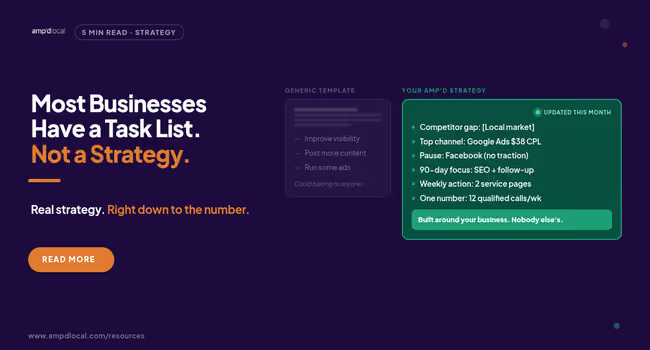
A real marketing strategy for small business starts with your competitors, your channel performance, and your actual goals and not a generic template with your business name swapped in. It tells you not just what to do, but why, and what changes when your market shifts.
And in 2026, the best ones are built using AI for small business marketing not to replace the thinking, but to surface patterns, analyze competitors, and keep the strategy current in a way no human alone could manage month to month.
TL;DR: A real marketing strategy is a living document built around your specific business, not a task list, not a one-size-fits-all plan, and not something you build once and file away.
What Most Small Businesses Have Instead of a Strategy
Let's be specific about what's usually passing for a strategy in most small businesses.
It's typically one of three things:
- A task list. "Post three times a week, run a Google Ad, send an email newsletter monthly." Tasks without context. No explanation of why these channels, why this frequency, or how to know if any of it is working.
- A generic plan from an agency or tool. Usually built on a template. Impressive-looking, with a competitor analysis section that lists three national brands and a strategy section that recommends the same six tactics regardless of your specific situation.
- Nothing written down at all. The strategy lives in the owner's head. It shifts week to week based on what feels most urgent, what a competitor just posted, or what a salesperson pitched last Tuesday.
According to Visible Marketing's 2026 report on small business planning, the most common result of marketing without a clear strategy is "activity without momentum — effort without traction." That describes most small business marketing exactly.
None of these are strategies. They're responses. And there's a significant difference.
What a Real Marketing Strategy Actually Contains
A marketing strategy for small business has five components. Every one of them is specific to your business, not a template, not a generic recommendation.
1. A competitor and market snapshot
Who is competing for the same customers you want? What are they doing that's working? Where are the gaps - the keywords they're not ranking for, the channels they're ignoring, the audience they're not speaking to?
This isn't a one-time exercise. Your market moves. A marketing planning software system that re-runs competitor analysis monthly tells you when a gap opens up or a competitor makes a move, so you can respond with a plan, not a panic.
2. A channel health audit
Not all channels are worth your time at your current stage. A business doing $150k/year has completely different priorities to one at $1.5M. A real strategy looks at what's already working for you even at a small scale and builds on it before adding new channels.
It also identifies where you're investing time and money that isn't generating returns. Most businesses have at least one of these. Knowing which one to pause is as valuable as knowing what to start.
3. A 90-day priority list
Not a 12-month content calendar. Not a year-long roadmap. A specific, sequenced list of the three to five things that will move your business the most in the next 90 days, given your current stage, your budget, and your goals.
As we covered in our post on why small businesses lose leads after the first click, the order matters as much as the tactics. Scaling ad spend before your follow-up system is working just amplifies a problem. Fixing conversion before scaling traffic is almost always the right sequence. A real strategy gets that order right.
4. A weekly action list tied to outcomes
The 90-day plan breaks down into weekly actions. Not "post three times." But: publish one blog post targeting this specific keyword, send a follow-up email to leads from the last two weeks, respond to all Google reviews within 24 hours.
Every action should connect to a measurable outcome. If it doesn't, it's activity, not progress.
5. One number to review every week
As we covered in our post on the only marketing number small businesses need to track, the businesses that grow consistently track one leading metric that connects their marketing activity to revenue. Without it, you're reviewing dashboards every week without knowing what to change.
A real strategy names that number and builds the weekly review around it.
Where AI Fits and Where It Doesn't
There's a lot of noise right now about AI marketing tools for small business. Most of the conversation focuses on content generation using AI to write social posts, draft emails, create ad copy. That's useful, but it's the least interesting thing AI does for marketing strategy.
The more powerful application of AI for small business marketing is in the analysis layer - the work that used to require an experienced marketing consultant or a full agency team:
- Competitor monitoring. AI can track competitor keyword rankings, content output, and ad activity on an ongoing basis, surfacing changes that would take a human analyst days to find.
- Channel performance patterns. AI identifies which combinations of activity are producing leads, at what cost, and at what point in the funnel things are breaking down.
- Keyword and content gap analysis. AI finds the search terms your competitors aren't ranking for but your audience is using, the specific opportunities most businesses miss because they're not looking.
- Strategy updates. As your performance data changes month to month, AI adjusts the strategy, surfacing what to prioritize next without waiting for a quarterly review.
Where AI still falls short is in judgment. It can surface the patterns. It can't tell you how your customers actually feel about your pricing, why your best client chose you over a competitor, or what a shift in your local market means for your positioning. That's the part that requires a real person who understands your business. According to Labile Consults' 2026 marketing research, "94% of buying groups are now using LLMs to vet solutions" which means the strategy that wins is AI-informed, not AI-only.
The best AI marketing strategy for small business uses AI where it has genuine advantages - analysis, pattern recognition, speed and keeps a real person accountable to whether the strategy is actually working for your specific business.
What Makes a Strategy Living Rather Than Static
This is the part most strategy frameworks miss.
A strategy built in January for the full year is already partially wrong by March. Your market has moved. A competitor launched something new. Your best-performing channel shifted. The keywords you targeted in Q1 have different competition now.
A living strategy updates. Not a complete rebuild every month but a review of what's changed, what's performing, and what the updated priorities should be. This is exactly what marketing planning software is supposed to do, but rarely does because most tools show you data without telling you what it means for your next decision.
The difference between a living strategy and a static one isn't the frequency of updates. It's whether the updates are driven by your actual performance data or by a calendar reminder. A real system connects the two automatically.
When your ads are generating traffic but your follow-up rate is low, the strategy updates to tell you to fix follow-up before scaling spend. When your email open rate improves but bookings are flat, it identifies the adjustment needed in the sequence. You don't wait for a quarterly agency review to find out what changed.
What a Real Strategy Looks Like in Practice: A Plumbing Business Example
Here's what the five components look like for a specific business - a mid-sized plumbing company in a competitive local market.
| Component | Generic / Template Version | Real Strategy Version |
|---|---|---|
| Competitor snapshot | "Top 3 competitors are X, Y, Z." | "Competitor A ranks #1 for emergency plumber [city] but has no GBP posts since March. Gap: emergency service content." |
| Channel audit | "Recommend Google Ads, SEO, social media." | "Google Ads generating leads at $38 CPL. SEO ranking p3 for main keyword. Facebook zero traction. Pause Facebook, invest in SEO content." |
| 90-day priorities | "Improve online visibility and generate more leads." | "(1) Publish 2 service-area pages for [suburb]. (2) Run emergency response campaign Sept-Oct. (3) Fix follow-up sequence for missed-call leads." |
| Weekly actions | "Post on social, check ads, send emails." | "Mon: respond to all new reviews. Wed: publish 1 local content post. Fri: check CPL vs last week and adjust ad targeting if >$45." |
| One number | "Track all metrics." | "Track: qualified calls booked per week. Target: 12. Current: 8. Gap: follow-up sequence." |
The specificity is the point. A generic strategy could belong to any plumbing business in any market. A real strategy belongs to this one.
How Your Amp'd Strategy Is Built
Every Amp'd Local client gets Your Amp'd Strategy, not a template, not a PDF, not a one-off document. A living strategy built by a real person, powered by AI, and updated every month as your business evolves.
Before we build it, we listen. Not to a questionnaire. To you, how you want to market your business, what you've already tried, what's felt like wasted time, what kind of customers you actually want more of. Your pain points, your goals, your market.
From that conversation, your dedicated marketing manager supported by AI powered marketing systems that have analyzed your competitors, your keyword landscape, and your channel performance builds a strategy with all five components above. Specific to your business. Not what worked for a similar client.
And it doesn't sit in a folder. It updates every month as your performance data comes in. When something changes in your market or your numbers, your strategy changes with it. That's what a real marketing planning software system should do and it's the difference between a strategy you follow and one you file away after the first month.
If you'd like to see what that looks like for your business specifically, book a free discovery call. We'll show you what a real strategy looks like built around your market, your stage, and the way you want to grow.
Stop Working From a Task List. Start Working From a Strategy.
The difference between a task list and a real marketing strategy isn't volume or complexity. It's whether every action connects to a clear goal, a specific sequence, and a way to know if it's working.
Most small businesses don't have that. Not because they aren't trying but because nobody ever showed them what one actually looks like. As we explored in our post on why you don't need a big agency to get one, the barrier is rarely budget. It's access to someone willing to build something real.
That's exactly what AI for small business marketing, done properly, makes possible. Not by replacing strategy with automation but by giving a real person the tools to build a genuinely specific, genuinely useful plan for your business. And then keeping it alive.