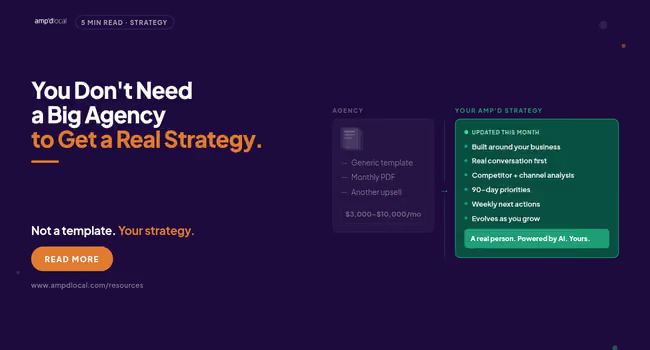
That's not what most agencies are built to do. Their strategies aren't personalized to your business, they're templates dressed up as custom plans. You're rarely told why a tactic matters, just that it's included in the package. And every conversation eventually turns into a pitch for another service, another retainer, another line item.
You don't need a big agency to get a real marketing strategy for small business. You need someone willing to give you a plan you can actually run yourself without the pressure to buy your way out of understanding it.
The Agency Model Wasn't Built for Small Businesses
According to ClicksGeek's 2026 Agency Pricing Guide, most local businesses pay between $2,500 and $10,000 per month for a marketing agency retainer. For a small business with a realistic marketing budget of $500–$2,000 a month, that's not just expensive, it's the entire budget before a single ad has run.
But cost is only part of the problem. The bigger issue is structural.
Agencies are built to serve multiple clients simultaneously. That means your account gets a portion of someone's time, a templated strategy built on what worked for a similar client, and reporting that shows activity — like impressions, posts, clicks — rather than outcomes. The person who understands your business — your margins, your seasonality, your actual goals — is usually not the person building your strategy.
The result is a familiar pattern for most small business marketing consulting engagements: you get a PDF document, a content calendar, and a monthly call where someone reads you numbers you don't fully understand. Three months later, the document is filed away and you're not sure if any of it is still relevant.
What's Actually Missing Isn't Budget — It's Clarity
Most small business owners we speak to aren't confused about what marketing channels exist. They know about Google Ads, SEO, social media, email. They've tried most of them.
What they're missing is clarity on three things:
- Which channels are worth their money at their current stage. A business doing $200k a year has completely different priorities to one doing $2M. A generic strategy doesn't account for that.
- In what order to do things. Most marketing advice treats every tactic as equally urgent. It isn't. Doing things in the wrong order wastes time and money.
- How to know if it's working. Without a clear metric and a way to act on it, every week feels like guesswork.
These are not questions that require a $5,000/month retainer to answer. They require a marketing strategy for small business that's built around how your specific business actually works — and not a template with your name on it.
What a Real Marketing Strategy for a Small Business Actually Contains
A real strategy isn't a task list. It's not a content calendar. And it's not a report showing what happened last month.
A real strategy answers these questions specifically for your business:
- Who are your best customers and where are they finding you right now?
- Which channels are generating leads at an acceptable cost and which ones aren't pulling their weight?
- What does your competitor landscape look like locally, and where are the gaps you can actually win?
- What's the logical sequence of activity for the next 90 days given your budget, your stage, and your goals?
- What's the one number to track each week that tells you whether it's working?
As we covered in our post on the only marketing number small businesses need to track, clarity on a single leading metric changes everything. Without it, you're reviewing dashboards every week without knowing what to do differently.
When a strategy answers all of those questions clearly, you don't need to call an agency to find out what to do next. The plan tells you.
The Problem With Most DIY Marketing Approaches
The answer to an expensive agency isn't trying to figure everything out yourself, either. Most small business owners who go the DIY route end up in a different version of the same problem.
They start by trying to do everything: post on Instagram, run a Google Ad, send some emails, do some SEO. Everything gets a little attention. Nothing gets enough. Progress is slow, and it's impossible to tell what's actually working because ten things changed simultaneously.
This is the core challenge of digital marketing for small business: without a structured plan, you're always reacting — to trends, to competitors, to whatever feels most urgent this week. A strategy gives you permission to ignore things that don't matter yet and focus on the ones that do.
The same holds for AI marketing tools. They can speed up execution significantly — as we covered in our post on what actually helps with AI marketing for small businesses, the businesses getting results from AI are the ones who sorted their strategy first and then used AI to execute faster within it.
What a Good Strategy Process Looks Like Without an Agency
You don't need a six-month agency engagement to get a useful strategy. You need a structured process that asks the right questions about your specific business and gives you a clear, actionable output.
Here's what that process should produce:
A competitor and channel audit
Before deciding what to do, you need to know where you stand. Which competitors are ranking above you locally? What are they doing that you're not? Which channels are already working for you, even at a small scale? A useful audit takes 30–60 minutes and tells you more than most agencies reveal in three months.
A prioritized 90-day plan
Not a 12-month roadmap. Not a content calendar. A specific sequence of activity for the next 90 days, ranked by the impact they'll have relative to your current stage. This is where most small business strategy falls apart — the order matters as much as the tactics.
A weekly action list tied to outcomes
The weekly actions should be short, specific, and directly connected to your marketing help for small business goals. Not "post three times this week." But: "publish one blog post targeting [keyword], send one follow-up email to leads from last month, respond to all Google reviews within 24 hours." Tasks that move a metric, not tasks that create activity.
One number to review every week
As we explored in our post on converting leads after the first click, the businesses that grow consistently are the ones that track one number that connects their marketing activity to revenue — and review it every single week without fail.
How Amp'd Local Builds Your Strategy Without the Agency Model
Amp'd Local was built specifically because the agency model doesn't work for most small businesses — and going fully solo doesn't either. The gap between them is exactly where small business marketing consulting services tends to sit, without ever quite delivering on either end.
Every Amp'd Local client gets Your Amp'd Strategy — not a template, not a PDF, not a one-off document. A living strategy built by a real person, powered by AI, and updated every month as your business evolves.
Here's what makes it different from anything an agency produces. Before we build your strategy, we listen. Not to a questionnaire. To you — how you want to market your business, not just what the data says should sell. Your pain points, your goals, your market, the way you think about growth. A real conversation, not a form.
From that, your dedicated marketing manager — supported by AI, having analyzed your competitors, your channel performance, and your local market — builds a marketing strategy for small business that is genuinely specific to you. What to focus on. In what order. Why each thing matters at your current stage. Not what worked for a similar client. What makes sense for your business, right now.
And it doesn't sit in a folder. It updates every month as your performance data comes in, as your goals shift, as your market changes. When your ads are generating traffic but your follow-up rate is low, your strategy tells you to fix follow-up before scaling spend. When your email open rate is strong but bookings are flat, it tells you to adjust the sequence. You don't wait for a monthly agency call to find out what to change. Your strategy already knows.
And if you want the execution handled too, Amp'd Services is built for that — so you can hand the strategy off entirely and focus on running your business.
Starting from $299/month, it's not a DIY tool and it's not an agency. It's the thing that should sit between the two for most small businesses.
You Don't Need to Spend $5,000 a Month to Have a Real Strategy
The agency model has conditioned small business owners to believe that a real strategy requires a big budget and someone else to run it. That's not true.
What it requires is someone willing to look at your specific business honestly, tell you what's worth doing and what isn't, and give you a plan clear enough that you can follow it yourself — or hand it to someone who can.
If you've been running marketing on instinct, trying a bit of everything, and feeling like nothing quite sticks — the answer isn't more budget. It's a marketing strategy for small business that was actually built around your business.
If you'd like to see what that looks like in practice, book a free discovery call and we'll show you.