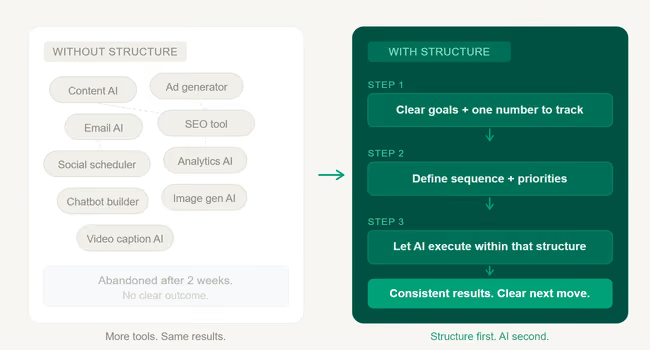
Most small business owners have tried at least a few of them. And most have had a similar experience: it works a bit, produces something decent, and then quietly gets abandoned because it never quite fits into how the business runs.
That's not an AI problem or a tool problem. It's a structure problem. And understanding that distinction is the difference between AI for small business marketing that actually moves the needle and AI that just adds to your to-do list.
The AI Tool Explosion — And Why Most of It Doesn't Help
According to HubSpot's 2026 State of Marketing Report, over 74% of marketers now use AI in some part of their marketing workflow. For small businesses, the most common use cases are content generation, email drafts, and social media captions.
Here's the problem: those are execution tasks. And doing execution tasks faster doesn't help if you're executing the wrong order.
Think about it this way. If your marketing plan is scattered, posting when you remember, running ads without a clear audience, sending emails with no follow-up sequence, then AI doesn't fix any of that. It just helps you scatter faster.
This is why the conversation around AI marketing tools for small businesses so often leads to disappointment. Business owners adopt a tool expecting it to solve a strategic problem, when really it's built to solve an execution problem. The strategic problem is still there, humming away in the background.
What AI Is Actually Good At (And What It Isn't)
Let's be specific. There are things that AI does genuinely well for small business marketing right now, and things it still can't do; no matter how advanced the tool is.
Where AI genuinely helps
- Writing faster. AI is excellent at generating first drafts. Ad copy, email subject lines, social captions, Google Business Profile descriptions. If you know what you want to say, AI can help you say it faster and test more variations.
- Repurposing content. Turn a blog post into five social captions, a short video script, and an email intro. AI handles this kind of structural transformation well.
- Researching and summarizing. Pulling together market research, competitor observations, or keyword ideas. AI saves hours here.
- Responding at scale. Review response templates, FAQ drafts, email reply frameworks. Keeps communication consistent without draining time.
Where AI still falls short
- Strategy. AI can't tell you which channel to prioritize for your specific business at your specific growth stage. It doesn't know your margins, your seasonality, or why last month's campaign underperformed and what you should be doing next.
- Sequencing. AI tools don't know what order to do things in, or which order is best for your business. They'll generate a content calendar, but they won't tell you whether content is even the right priority this quarter.
- Decision-making from your data. AI can analyze data you feed it, but it can't connect to your Google Analytics, ad spend, and email performance and tell you what to do next. Not yet.
The businesses getting real results from AI for small business marketing are not the ones with the most tools. They're the ones who sorted their marketing foundation first — clear goals, a defined sequence, a way to measure what's working — and then used AI to execute faster within that structure.
The Tool That Looks Useful But Usually Isn't
The most common AI tools small businesses try first are the all-in-one content generators. Type in your business name and niche, and it produces a week's worth of social posts, a few email ideas, and some ad headline options.
It's impressive the first time. And then you start to notice that everything sounds slightly generic. The captions and content could belong to any business in your industry. The email subjects are fine but not compelling. The ad headlines are technically correct but miss the specific thing that makes your business worth choosing.
This is what we explored in our post on generic AI task lists vs a real marketing playbook. The output of a generic AI tool reflects the average of everything it's been trained on. Your business isn't average. Your customers, your location, your offer, and your competitive position are specific — and that unique selling point is exactly what generic AI tools can't account for.
Generic content output is better than nothing. But it's not the thing that builds a business.
The Three AI Tools Worth Your Time
Given the noise, here are the categories of AI tools that genuinely move the needle for small businesses when used correctly:
1. AI-assisted copywriting (with your input)
Tools like ChatGPT, Claude, or dedicated ad copy tools work best when you bring the brief. The clearer your input — target customer, pain point, offer, tone — the better the output. Use them as a writing partner, not a ghostwriter. The best use: generating five versions of an ad headline or email subject line so you can test what resonates, rather than agonizing over one version for an hour. For practical prompts you can use right now, see our AI prompt pack for small business marketing.
2. AI-powered scheduling and analytics
Tools that help you see patterns in your existing data — when your audience is most active, which post types get the most engagement, which email send times perform best — are genuinely useful. They take decisions that used to require gut feel and give them a data backbone. The catch: they still show you what happened, not what to do next. That gap is still yours to close.
3. AI-driven playbook systems
This is the category that's emerging and where the real value lies for small business marketing. Rather than just generating content or showing analytics, these systems connect your performance data to a recommended next action. As we covered in our piece on why dashboards alone don't grow businesses, the gap for most small businesses isn't data — it's the decision that should follow the data. AI systems that close that gap are the ones worth investing time in.
Structure First. AI Second.
Here's the order that works:
- Get clear on your goals. What does success look like in 90 days? More leads? Better conversion? More repeat customers? AI can't set priorities for you.
- Define your sequence. Which channels make sense for your business at your stage? What is the logical order? A new business building awareness has a completely different sequence to an established business with leads that are not converting.
- Identify your one number. As we covered in our post on the only marketing number small businesses need to track, you need one clear metric that tells you whether your marketing is working. Without it, you have no way to evaluate whether your AI tools are helping or if it's just another distraction.
- Then let AI execute. Once the structure is in place, AI becomes genuinely powerful. It helps you move faster, test more, and maintain consistency without burning hours every week.
The businesses winning with AI right now aren't the ones who adopted it earliest. They're the ones who used it within a system. Strategy first, execution second.
What We're Building at Amp'd Local
Amp'd Local is built around this principle. We don't just give you AI-generated content or a tool to speed up execution. We build you a personalised marketing playbook that connects your performance data to your next action.
That means when your ads are driving traffic but your follow-up rate is low, the system tells you to fix follow-up before scaling spend. When your email open rate is good but bookings are flat, it tells you to adjust the sequence and not the subject line. This is what "AI for small business marketing" looks like when it's built around structure, not just speed.
You can read more about how we've built around this in our 90-day AI marketing playbook for small businesses.
The Honest Summary
AI marketing tools are useful. Some of them are excellent. But the tool is never the answer on its own.
The businesses that get results from AI are the ones that brought clarity to their marketing first — clear goals, a logical sequence, a way to measure what's working — and then let AI execute within that clarity.
If your marketing feels scattered right now, adding another AI tool won't fix it. Sorting the structure will.
Once the structure is there, AI stops being a distraction and starts being a genuine advantage. If you'd like to see what that looks like in practice, see how Amp'd Local builds your playbook.