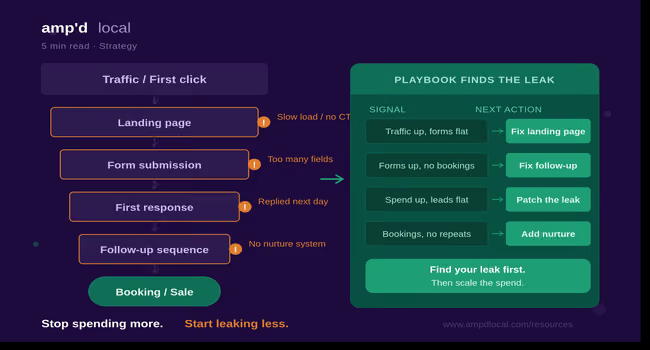
And for a lot of small business owners, that's exactly what they do. They invest in visibility. They get the traffic. The clicks come in.
And then nothing happens.
The phone doesn't ring. The form submissions don't turn into appointments. The enquiries go quiet. And the instinct understandably is to spend more on ads, get more traffic, and hope the numbers improve.
But the problem almost never lives in the traffic. It lives in what happens after the click. And until you find where the leak is, spending more will only make it worse. As Analytics & Beyond Marketing put it: if your current leads are not converting, increasing volume simply multiplies inefficiency.
This blog breaks down exactly where small businesses lose leads after the first click — and how a structured marketing playbook finds the leak so you can fix it before scaling spend.
The Traffic Trap: More Clicks, Same Results
Here's a scenario that plays out constantly across local business marketing.
A home services business runs Google Ads. Traffic goes up. Cost per click looks reasonable. The campaign dashboard shows green arrows.
But bookings are flat. Revenue hasn't moved.
So the instinct is to increase budget, test new ad copy, or try a different platform. None of it works because the problem isn't the traffic. The traffic is doing its job. Something downstream is broken.
This is the traffic trap. It's one of the most expensive mistakes in digital marketing for small business and it happens because most businesses measure the top of the funnel (clicks, impressions, traffic) and ignore everything that comes after.
The fix starts with understanding exactly where leads are exiting. Not guessing. Knowing.
The 5 Places Small Businesses Lose Leads After the First Click
Most lead leaks happen in one of five places. Understanding which one applies to your business tells you exactly what to fix and in what order.
1. The landing page doesn't convert
Someone clicks your ad or finds you in search. They land on your page. And within seconds, they've left.
The most common reasons: the page loads slowly, the message doesn't match what the ad promised, there's no clear offer, or the next step isn't obvious. A strong ad driving traffic to a weak page is money going straight down the drain.
According to Google's research on mobile page experience, pages that load in under 2 seconds convert significantly better than those that take 4 or more. For most small business websites, page speed alone is a conversion problem that never gets addressed.
2. The offer isn't clear enough to act on
Even when a page loads fast and looks good, leads stall if the offer is vague. "Get in touch" is not an offer. "Free 20-minute consultation this week" is.
The specificity of your CTA matters more than most business owners realise. Unbounce's 2026 Conversion Benchmark Report found that pages with a single, specific CTA convert at nearly double the rate of pages with multiple or generic calls to action. Clarity beats cleverness every time.
3. The form asks for too much
Form friction is one of the most overlooked lead killers in small business marketing strategies. Ask for a name, email, phone number, project description, budget range, and preferred contact time — and watch conversion rates drop with every additional field.
The instinct behind long forms is understandable: you want to qualify leads before spending time on them. But the prospect doesn't know that. They just see a barrier. Keep forms to three fields maximum at the first touchpoint. Qualify later.
4. Follow-up is too slow
This is the single most expensive lead leak for most service businesses. Research from Harvard Business Review showed that businesses responding to leads within an hour are nearly seven times more likely to have a meaningful conversation than those responding even an hour later. After 24 hours, the odds drop dramatically.
Most small businesses follow up the next day. Or end of week. Or when they remember. By that point, the lead has found someone else, moved on, or simply gone cold.
The issue isn't usually laziness. It's the absence of a marketing automation for small businesses system that handles the first response automatically, so speed isn't dependent on the owner being available at the exact moment a lead comes in.
5. There's no nurture sequence after the first contact
Most leads don't convert on first contact. They need to see your business two, three, or five times before they're ready to commit. Without a follow-up sequence, every lead that doesn't book immediately is effectively lost.
As we covered in our blog on email marketing for small businesses, email is the most cost-effective nurture channel available — but only when it's structured as a sequence, not a one-off broadcast. A single follow-up email is not a system. Three to five touchpoints over two weeks is a system.
Why Most Small Businesses Can't Find the Leak
Here's the frustrating part.
Most of the five problems above are fixable. None of them require a big budget. But you can't fix what you haven't identified. And for most small businesses, identifying the specific leak in their funnel is nearly impossible with the tools they have.
Google Analytics tells you traffic numbers. Your ad platform shows click data. Your email tool shows open rates. But none of them tell you: at which point in the journey did this particular group of leads stop engaging?
This is the gap that marketing strategy for small business consistently fails to address. Data without context isn't useful. And context without a structured playbook to act on it is just more confusion.
Most small businesses end up in one of two positions: they either don't have enough data to diagnose the problem, or they have too much data and can't see the signal through the noise. As we explored in our post on dashboards that don't grow businesses, the issue isn't usually a lack of data. It's the absence of a system that connects the data to a clear next action.
How a Marketing Playbook Finds the Leak
A marketing playbook for small businesses approaches the lead leak problem differently from a standard analytics tool. Instead of showing you what happened, it connects your performance signals to a specific next action.
Here's how that looks in practice:
- Traffic up, form submissions flat: The leak is on the landing page. Playbook next action: review page load speed, CTA clarity, and offer specificity before increasing ad spend.
- Form submissions up, bookings flat: The leak is in follow-up speed or the first response. Playbook next action: implement an automated first-response email within 5 minutes of form submission.
- Bookings up, repeat business flat: The leak is in post-sale nurture. Playbook next action: build a 3-email post-service sequence to drive reviews and referrals.
- Traffic flat despite ad spend: The leak is in targeting or creative relevance. Playbook next action: audit audience match between ad copy and landing page message.
Each of these is a decision, not just a data point. The playbook reads the signal and tells you what to fix first, so you're not guessing, and you're not scaling spend into a broken funnel.
This is precisely why structured digital marketing strategies for small businesses consistently outperform scattered tactics. It's not that the tactics are different; it's that the order and diagnosis are built into the system.
Fix the Leak Before You Scale the Spend
The most important marketing principle most small businesses ignore:
You cannot scale your way out of a conversion problem.
More traffic into a leaking funnel produces more leakage. The math never changes. A 2% conversion rate with 1,000 visitors gives you 20 leads. A 2% conversion rate with 10,000 visitors gives you 200 leads — but you've spent ten times as much to get there, and the underlying problem is still there waiting for you.
Fix the conversion rate first. Then scale the traffic.
This is the sequence that local business marketing strategies consistently gets wrong because visibility is exciting, and conversion optimisation is invisible. Nobody celebrates fixing a form. But fixing a form might double your leads without spending a single extra dollar on ads.
As we covered in our post on the only marketing number small businesses need to track, lead conversion rate is the single metric that tells you whether your marketing system is working. Everything else is a supporting signal.
The Honest Audit: Where Is Your Leak?
Before you run another ad or publish another piece of content, work through this sequence:
- Step 1 — Check your landing page. Load it on your phone. Does it load in under 3 seconds? Is the offer immediately clear? Is there one obvious next step?
- Step 2 — Check your form. Count the fields. If there are more than three, reduce them. Test whether submissions increase.
- Step 3 — Check your first response time. How long does it take for a lead to hear back from you after they submit a form or call? If the answer is "it depends," that's the leak.
- Step 4 — Check your nurture sequence. After the first contact, how many times does a lead hear from you before they either book or go cold? If the answer is once or never, that's the leak.
- Step 5 — Check your conversion rate. Of everyone who showed genuine interest this month, how many became paying customers? If you don't know this number, finding it is the first task.
These five questions will tell you more about your marketing than any dashboard.
What Amp'd Local Does Differently
Most marketing help for small business focuses on generating more leads. Amp'd Local is built around a different question: are the leads you already have being handled correctly?
Your personalised marketing playbook doesn't just tell you what channels to use. It connects your performance data to your specific funnel stage and surfaces the leak that's costing you the most — whether that's a slow follow-up, a weak landing page, or a missing nurture sequence.
And with Amp'd Services, you don't have to fix it yourself. Once the playbook identifies the issue, our team handles the execution — from writing the follow-up email sequence to optimising your landing page copy.
You don't need more traffic. You need a marketing strategy for small business that makes the most of the traffic you already have. That starts with finding the leak.
If you're not sure where yours is, see how Amp'd Local builds your playbook — and where it tells you to look first.
Stop Spending More. Start Leaking Less.
The leads are there. The clicks are coming in. The problem is what happens next.
Find the leak. Fix it. Then scale.
That's the order that works for lead generation for small business and it's the order your playbook is built around.