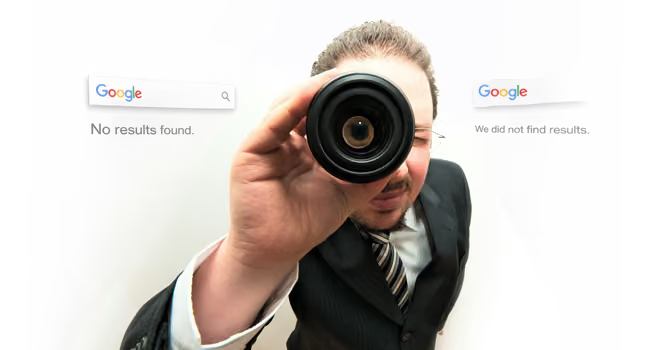
The fact is even more outrageous: the demand is present, yet not visible. Customers are making, comparing and making decisions daily. As long as your business is not featured in such key moments of your life, you are invisible and invisibility kills opportunities even before they are considered.
This is exactly what the so-called AI-based marketing platform, like Amp’d Local, aimed at targeting small business, is developed to deal with.
The Demand Has Gone Online (And You Have or Have Not)
The manner in which customers locate local businesses has radically changed:
- Location-based searches and "near me" are continuously increasing year after year as AI assistants and voice search are normal.
- The organic visibility of business pages on the biggest social media is reduced to single-digit figures, and the payment-to-play policy has become a standard.
That is to say, though you may have the best clinic, bakery, plumbing service, or law firm in town, you remain invisible in the places customers go unless you have changed.
Why Customers Can’t Find Your Business Online
The majority of the visibility issues are categorized into several foreseeable patterns.
1. You are not found on important discovery channels.
Having a website is no longer enough. Discovery is spread over:
- Google Search and Google Maps.
- Apple Maps and large local directories.
- Social platforms (Facebook, Instagram, TikTok, LinkedIn).
- Review sites and site-specific review sites.
The typical gaps that render you virtually invisible:
- Unclaimed or unfinished Google Business Profile (GBP).
- Obsolete information in the directories (different name, address, phone)
- Inactive social accounts that do not show any recent activity or content.
To a customer, this appears as though you do not even have a business. Algorithms will view you as not credible enough to show.
2. You are talking your language and not that of your customers
It is one of the most widespread and costly mistakes. The owners write what they are doing, yet customers are searching for what they need.
- The company: Boutique holistic wellness and movement studio.
- The customer: physical therapy near me, sports injury clinic.
The intent signals and natural language are heavily relied upon by search engines and AI assistants. When your site, your Google business profile, and your advertising campaigns are written in some vague or internal language, the algorithms fail to relate you to what is really being searched in the real world.
Symptoms that may be occurring:
- Your pages have no definite names of services, conditions, and issues you solve.
- You do not see a lot of search terms that have intent in your analytics or ad reports since you are not tracking them.
In effect, you are actually talking loudly, however not in the language your customers speak.
3. You are getting some clicks but losing them when they arrive
Visibility is only the first step. When individuals discover you but do not remain, call or book, sites demote your content in the long run.
Pain points that kill online presence of a business silently:
- Slow mobile page loads (more than 3 seconds are counterproductive).
- Lack of obvious call-to-action: a visitor will have to find out how to get in touch with you.
- No online booking and/or click-to-call, particularly on mobile.
- Poor design that sends the message of being neglected or unreliable.
- Few or no reviews, testimonials, and evidence that you provide results.
The current algorithms monitor the post-click behavior of the users. When they bounce fast or fail to do so, this sends a negative signal of relevancy, and this reduces your visibility even more.
4. Your online activity seems to be dormant or unreliable.
Signals of activity and trust are judged by customers and algorithms:
- Are there any recent reviews?
- Do you react to such reviews?
- Are there up-to-date photos, posts, or updates?
- Do you have information that is consistent and accurate all the way?
An active business that has its reviews, updated hours, and frequent postings will almost always be ranked higher than a similar business that seems to be inactive, even though the inactive one may be older than this one.
An Actionable Model: Reach, Relevance, Response
Successful marketers do not depend on haphazard strategies. A straightforward, efficient model of small business for improved online visibility is the Reach-Relevance-Response model:
- Reach - Do you have access to the customers and algorithms?
- Relevancy - Do they know what you do and who you serve?
- Reaction - Do they act when they find you?
The Real Problems Are Not Demand. It’s Discoverability
When the service is good, but the requests are sporadic, then assume the following: the customers are there, but they cannot locate you.
The winning businesses do not necessarily have the best offerings. They are the ones that are:
- Easiest to discover,
- Easiest to understand,
- Easiest to choose.
Get yourself seen, and you will find that it was not demand that was the issue; it was your discoverability all along.
How do you behave when the thought of being monitored on the internet comes to mind?
To do this, the first thing to do is to undertake a simple, systematic visibility audit on yourself as a prospective customer would. Google your core services and your city, see whether you have a Google Business Profile listed in the local pack, look at the number of reviews you have gotten recently, and browse your own site on a mobile phone to see how fast it loads and how easy it is to get in touch with you. When you are not consistently on page one on the high-intent local searches, when your listings look unfinished or older than a year, and when it takes you several seconds and one button press to call or reserve, then you have a visibility issue, not a demand issue, and that diagnosis will tell you exactly where to invest your next marketing.